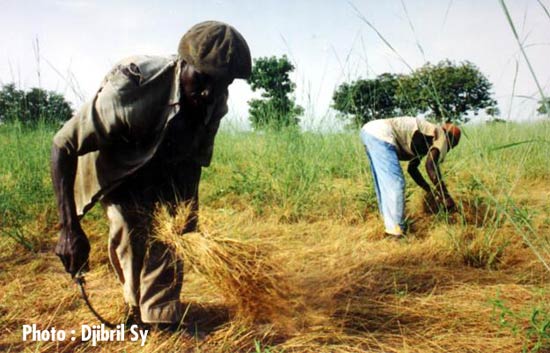
So why Fonio (hungry millet, finger millet, this grain goes under many more names)? I've been investigating this grain on and off for about a year now. To say the least it surprises me that such a highly nutritious grain, "Super food", exists on the continent of Africa (all across the continent) with little knowledge of its' benefits outside of Africa and India - I guess it shouldn't surprise me. Thanks Nicole. Please find information attached to the bottom of this entry that will help you become more knowledgeable about this powerful grain.
I have a love affair with is grain. A grain that the Dogon supposedly call the Po or Life Force - from which all this originate.
I will be distributing Fonio/Hungry Millet - in many forms - grown in both Mali and Senegal, West Africa in the very near future. Please look out for updates.
 Fonio is a small annual herbaceous plant of the genus digitalis that grows to a height of 30 to 80 cm. Fonio is considered to be the oldest cereal in West Africa. In the Malian Dogon tribe's legend of the origin and creation of the universe, the fonio grain, is known aspo, the "germ of the world".
 Fonio produces rough grains, which still have their glumes(characteristic chafflike bracts of the inflorescence of grasses, sedges at the base of a spikelet)and lemmas (bract in a grass spikelet just below the pistil and stamens) after threshing. At this stage, the grain is known as raw or "paddy" fonio. Paddy fonio, the tip of which still has its seed coating, is oval with one slightly flattened side. The grains are very small (L: 1.5 mm, W: 0.9 mm). On average, there are 1000 grains in half a gram.
 Hulled fonio grains have a shiny pericarp whose colour varies from white through yellow to purple. They have a hilum on one side and a relatively large germ, containing the fat reserves, on the other. The kernel, which is the main storage organ, is made up of starch grains and a small protein reserve. It is the main element in whitened fonio. Fonio is highly nutritious.
 Fonio is a small annual herbaceous plant of the genus digitalis that grows to a height of 30 to 80 cm. Fonio is considered to be the oldest cereal in West Africa. In the Malian Dogon tribe's legend of the origin and creation of the universe, the fonio grain, is known aspo, the "germ of the world".
White fonio (Digitaria exilis) is primarily grown in Guinea, where it is a staple for people living in the mountain regions of Fouta Djalon. It is also found in Mali, Burkina Faso, Ivory Coast, Nigeria, etc. In West Africa: Digitaria exilis or fonio, white fonio, fundi or findi, acha, hungry rice. Digitaria iburua or black fonio, iburu. In Eastern Europe: Digitaria sanguinalis or large crabgrass or hairy crabgrass. In India: Digitaria cruciata or raishan. Only Digitaria exilis is of any real importance in West Africa nowadays.
 Fonio produces rough grains, which still have their glumes(characteristic chafflike bracts of the inflorescence of grasses, sedges at the base of a spikelet)and lemmas (bract in a grass spikelet just below the pistil and stamens) after threshing. At this stage, the grain is known as raw or "paddy" fonio. Paddy fonio, the tip of which still has its seed coating, is oval with one slightly flattened side. The grains are very small (L: 1.5 mm, W: 0.9 mm). On average, there are 1000 grains in half a gram.
 Hulled fonio grains have a shiny pericarp whose colour varies from white through yellow to purple. They have a hilum on one side and a relatively large germ, containing the fat reserves, on the other. The kernel, which is the main storage organ, is made up of starch grains and a small protein reserve. It is the main element in whitened fonio. Fonio is highly nutritious.
The nutritional composition of fonio differs little from wheat. The husked grain white fonio contains 8 to 10%percent protein (the black fonio has a protein content of 11.8%), carbohydrates 85%, fat 4 %, ash 1%.
The protein analysis of white fonio in comparison with a whole egg is: 7.3 percent of methionine, 46 percent of lysine, 72% isoleucine, 90-100% of valine, tryptophan, threonine, and phenylalanine, 127% of leucine; 175% of total sulfur; and 189 percent for methionine.
The protein analysis of white fonio in comparison with a whole egg is: 7.3 percent of methionine, 46 percent of lysine, 72% isoleucine, 90-100% of valine, tryptophan, threonine, and phenylalanine, 127% of leucine; 175% of total sulfur; and 189 percent for methionine.
Furthermore, fonio does not contain any glutenin or gliadin proteins which are the constituents of gluten, making this cereal suitable for people with gluten intolerance.
Fonio grain is used in a variety of ways. It is used to make porridge and couscous, ground and mixed with other flours to bake breads, popped and brewed for beer. It is a good substitute for semolina in the making of pastas and shortbread biscuits. The best way to cook fonio is steaming or boiling for about 20 minutes.
In the Hausa region of Nigeria and Benin, people prepare a wusu-wusu (couscous) using both types of fonio. In northern Togo, the Lambas brew the tchapalo (the most famous beer of the country) from white fonio. In southern Togo, the Akposso and Akebou peoples prepare fonio with beans in a dish that is reserved for special occasions.
In the Hausa region of Nigeria and Benin, people prepare a wusu-wusu (couscous) using both types of fonio. In northern Togo, the Lambas brew the tchapalo (the most famous beer of the country) from white fonio. In southern Togo, the Akposso and Akebou peoples prepare fonio with beans in a dish that is reserved for special occasions.
I recieved quite few e-mails asking me where fonio can be purchased, so there is the only online shop the I am aware of:
Useful links about gluten intolerance: