Wednesday, December 9, 2009

Fonio

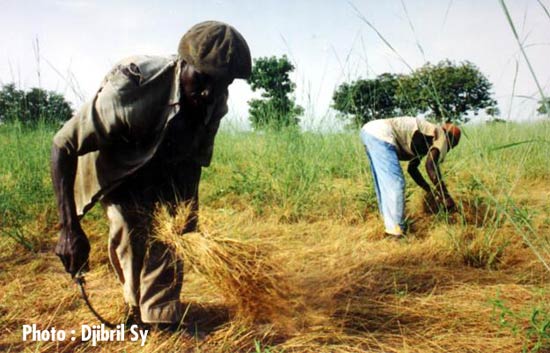
So why Fonio (hungry millet, finger millet, this grain goes under many more names)? I've been investigating this grain on and off for about a year now. To say the least it surprises me that such a highly nutritious grain, "Super food", exists on the continent of Africa (all across the continent) with little knowledge of its' benefits outside of Africa and India - I guess it shouldn't surprise me. Thanks Nicole. Please find information attached to the bottom of this entry that will help you become more knowledgeable about this powerful grain.

I have a love affair with is grain. A grain that the Dogon supposedly call the Po or Life Force - from which all this originate.

I will be distributing Fonio/Hungry Millet - in many forms - grown in both Mali and Senegal, West Africa in the very near future. Please look out for updates.
Fonio is a small annual herbaceous plant of the genus digitalis that grows to a height of 30 to 80 cm. Fonio is considered to be the oldest cereal in West Africa. In the Malian Dogon tribe's legend of the origin and creation of the universe, the fonio grain, is known aspo, the "germ of the world".
White fonio (Digitaria exilis) is primarily grown in Guinea, where it is a staple for people living in the mountain regions of Fouta Djalon. It is also found in Mali, Burkina Faso, Ivory Coast, Nigeria, etc. In West Africa: Digitaria exilis or fonio, white fonio, fundi or findi, acha, hungry rice. Digitaria iburua or black fonio, iburu. In Eastern Europe: Digitaria sanguinalis or large crabgrass or hairy crabgrass. In India: Digitaria cruciata or raishan. Only Digitaria exilis is of any real importance in West Africa nowadays.

Fonio produces rough grains, which still have their glumes(characteristic chafflike bracts of the inflorescence of grasses, sedges at the base of a spikelet)and lemmas (bract in a grass spikelet just below the pistil and stamens) after threshing. At this stage, the grain is known as raw or "paddy" fonio. Paddy fonio, the tip of which still has its seed coating, is oval with one slightly flattened side. The grains are very small (L: 1.5 mm, W: 0.9 mm). On average, there are 1000 grains in half a gram.

Hulled fonio grains have a shiny pericarp whose colour varies from white through yellow to purple. They have a hilum on one side and a relatively large germ, containing the fat reserves, on the other. The kernel, which is the main storage organ, is made up of starch grains and a small protein reserve. It is the main element in whitened fonio. Fonio is highly nutritious.
The nutritional composition of fonio differs little from wheat. The husked grain white fonio contains 8 to 10%percent protein (the black fonio has a protein content of 11.8%), carbohydrates 85%, fat 4 %, ash 1%.
The protein analysis of white fonio in comparison with a whole egg is: 7.3 percent of methionine, 46 percent of lysine, 72% isoleucine, 90-100% of valine, tryptophan, threonine, and phenylalanine, 127% of leucine; 175% of total sulfur; and 189 percent for methionine.
Furthermore, fonio does not contain any glutenin or gliadin proteins which are the constituents of gluten, making this cereal suitable for people with gluten intolerance.
Fonio grain is used in a variety of ways. It is used to make porridge and couscous, ground and mixed with other flours to bake breads, popped and brewed for beer. It is a good substitute for semolina in the making of pastas and shortbread biscuits. The best way to cook fonio is steaming or boiling for about 20 minutes.
In the Hausa region of Nigeria and Benin, people prepare a wusu-wusu (couscous) using both types of fonio. In northern Togo, the Lambas brew the tchapalo (the most famous beer of the country) from white fonio. In southern Togo, the Akposso and Akebou peoples prepare fonio with beans in a dish that is reserved for special occasions.
I recieved quite few e-mails asking me where fonio can be purchased, so there is the only online shop the I am aware of:
Useful links about gluten intolerance:
Winter Heat

Winter is here in Southern Ontario.

Composting in the cold of winter is still very possible. The most important technique to composting all year long in cold climates is to keep the compost as full as possible. The second method of an active compost during the winter months is to cover the compost:


Keep it going.

Saturday, December 5, 2009

Sustainability


As the winter months creep in upon us and the cooler weather sets in, especially up here in Southern Ontario, a sign of the winter months; global warming takes on a different persona.

The nights are longer. The air is drier. And yes the cold is biting. It's the first week in December and the temperature has remained a few degree's above seasonal norms throughout the fall. So what does this mean for me and my notions of sustainability? Well to be perfectly honest it doesn't have much of a direct effect on me personally.

In my current urban living situation; I rent which includes utilities and I utilize public transportation.

But I realize that I don't live on a planet all to myself nor do I inhabit a residential/ community all to myself. So sustainability takes on a different subtext in my life. It encompasses the broader community. For instance even though I don't pay for utilities I still use them. And since making any major modifications to my current living environment is not encouraged I am very conscious of my water usage as well as my energy consumption (I collect rain water for my garden, fish, indoor plants, and some washing). I still buy the majority of my food from local organic Farmers Markets. I use organic and environmentally friendly cleaners. And like I mentioned in the above paragraph I take public transport or ride my bike when I can.

Included in my rental property is a small plot of land. I am taking complete advantage of this "green" opportunity. I have constructed no less then 3 compost areas. Two of which I have almost completely filled with organic vegetable matter both from my kitchen and from that which I carry in from outside. In the 3rd area I have combined cow manure with leaves and last years dead growth. I I realize that by taking these small measures I'm also helping to heal my city and world.

Sustainability in my current world view also incorporates an organic feed back relationship one modality into another. These loops enable growth and abundance but at a rate helps both the producer and the consumer view production more responsibly. A "superior" product is worth waiting for. More to come...

I will cover areas of health, both human and planetary, in following entries.

HTP

Wednesday, December 2, 2009

Black Star Media


Living In Black
360 Degrees of the Black Experience
A message to all members of Living In Black

As Dr. John Henrick Clarke warned us in the early 1990's: We are truly at a crossroads. Our movement of cultural consciousness, black nationalism and Pan Africanism has had significant accomplishments, of various scales of success, over the decades. Nonetheless, as we look at the major areas of social and economic interaction, our global African family is still greatly challenged by a myriad of maladies.

Every country where Blacks can be found in great numbers we remain economical restricted, our males are being excluded and imprisoned, the family is in dire crisis, our places of residence are being colonized by outsiders and mined for profits without conscience, infant mortality remains the highest of all racial groups, our leadership sells our our collective self interests for the cheapest of gain for themselves, and the agencies that we would elevate to serve our best self interests are largely ineffective because of a severe starvation of capital resources necessary to accomplish their aims.

Amidst all of that pessimistic outlook, there rise a number of bright lights that have shown their capability to resist the downward spiral and to show that a completely different future can be attained. We at Black Star Media aim to be the means by which these bright lights are articulated and amplified. Over our years we have showcased the voices of healing, teaching, organization and profound research. We have also supported some of the most productive Pan African development projects in the world. Yet, our best work is in the next 2-3 years.

We have wonderfully ambitious new strategies which you will hear about over the coming weeks and months. Two times a year we come to you our listening audience and ask for your material support. The expenses of running an independent, non-profit broadcast network are immense and overwhelming. Yet, the spirit of Harambee (Let's all pull together) has proven that we can persist and rise in stature, against the tide of decay and neglect all around us.

We are asking that you make a donation using the following link to support our goal of raising $25,000 for the next level of expansion of our Internet Protocol Television expansion. We are also about to launch a series of broadcast sites throughout the African continent. This is a very deliberate set of plans. This can work and it will fulfill the dictates of our Great Ancestors and Wise Elders.

Please consider making a one-time $30 donation to this powerful vision. You will receive a wonderful package of material to show our value to your family and our community. You will also be a part of a winning strategy. Please, also share this message with those in your circle of support and ask them to join us at www.LivingInBlack.com to help define this collective future.

Keidi Awadu
President of Black Star Media Group

Saturday, October 24, 2009


So I missed my opportunity to see Vandana Shiva at U. of T. on Thursday. Was I disappointed -- no not really. I mean I really was looking forward to being in attendance but I rarely get disappointed. Everything in its' time.

For those who don't know of Vanadana Shiva or of her work I will direct you to both this video (to follow) as well as one of her websites: navdanya.org.


Any one so dedicated to seed preservation is all right with me.

So as I proceed with my own cultivation of the earth, atmosphere, and beyond; of seed cultivation, renewalbe reporduction of abundance I awaken a dormant knowledge.

I must thus return to the institution of composting, "mulching", and burning and often forgotten but very necessary aspect of cleansing and rejuvination.

COMPOSTING:

What Wikipedia has to say:

Composting is the purposeful biodegradation of organic matter, such as yard and food waste. The decomposition is performed by micro-organisms, mostly bacteria, but also yeasts and fungi.[1] In low temperature phases a number of macro-organisms, such as springtails, ants, nematodes, isopods and earthworms also contribute to the process, as well as soldier fly, fruit flies and fungus gnats. There are a wide range of organisms in the decomposer community.[2]

A biodegradable material is capable of being completely broken down under the action of microorganisms into carbon dioxide, water and biomass. It may take a very long time for some material to biodegrade depending on its environment (e.g. wood in an arid area versus paper in water), but it ultimately breaks down completely. Many contaminating materials not dealt with in common composting are in fact "biodegradeable", and may be dealt with via bioremediation, or other special composting approaches.[3]

...A compostable material biodegrades substantially under specific composting conditions. It is metabolized by the microorganisms, being incorporated into the organisms or converted into humus. The size of the material is a factor in determining compostability, reduction can speed the process.

Some people call this "Garden's Gold". Nature needs companions in soil conservation and renewal. So composting becomes a method of helping Nature do what is does but at a quickening rate. If done correctly, "biodiversity" being the key word here,

Truley sustainable -- organic agriculture -- is at one with the insects "bugs", pollinators, birds, animals, trees, and water systems.

Composting is recycling at its' finest. It's easy and it saves money! Of course there are methods of composting that combine knowledge of composting product "matterials used" and land. Though the act of composting is relatively simple there are some methodologies that need to be understood before one attempts to go forward with their own composting project.

Here are some online resources:

www.Composters.com
www.Compostguide.com
www.ciwmb.ca/gov/Organics

MORE TO COME

Friday, October 9, 2009

Building Our Own Global Communications Infrastructure - GTUC FM Internet Broadcast - Living In Black

Building Our Own Global Communications Infrastructure - GTUC FM Internet Broadcast - Living In Black

Donate to the FM / Internet broadcast station for the Ghana Telecom University Project

I would like to bring your attention to something I feel is very imparative as well as very timely. The Ghana FM/ Internet broadcast station represents more then a mere viable post to claim a global identity in which the unique voices of Ghana can be broadcast.

For too long continental African voices have been muted and/or filtered through foriegn dialogues. Realities of life throughout the continent need a truthful and unifying voice that not only educates African peoples of the Diaspora but also illuminates those continental Africans that have been disconnected from their neighbour.

Building Our Own Global Communications Infrastruction - GTUC Internet Broadcast

Building Our Own Global Communications Infrastructure - GTUC FM Internet BroadcastPosted by Keidi Awadu on August 1, 2009 at 1:46pm in Black Nationalism and Pan Africanism

This October and November, www.AfricaForTheAfricans.org will once again direct a group of us to journey home to Ghana, Benin and Togo for our annual sojourn. One of the primary goals of this particular tour group is development, business partnership, establishing continental banking accounts and infrastructure investment. We hold business conferences, make donations to schools, support an orphanage, visit banks and make small and large investment in indigenous business.

One of the primary focuses on this upcoming October 2009 / 6250 trip is to install a LIB affiliated broadcast station at the Ghana Telecom University College (GTUC), located in the capital Accra. This will be about the 12th station that we have contributed toward and the first on the African continent, in addition to other stations in London, Washington, Southern California, Baltimore, Florida, and more.

The station will include a 100 watt FM radio transmitter capable of reaching as much as half of the population of the nation's capital. As well, it will include Internet radio and television capability. The station will be a training ground for the next generation of Ghanaian broadcast professionals and technicians, as well as an important communications portal through which communications between the students and the people of Ghana will be more accessible to the world.

The studio installation will be a partnership between the Ghanaian government, who has donated the facility for the new school, private industry with the large services provider Ghana Telecom, the students of the school and we the African Diaspora.

Black Star Media, the parent of Living In Black, will be partnering with a non-profit organization to raise a sum of $10,000 to install this station. The money will purchase extensive broadcast equipment and studio equipment as well as travel fees, a percentage for the non-profit as well as commission to remain in Ghana for an extra 5 days to train the staff of the new station. This will NOT be a profit making venture. This WILL be an infrastructure venture.

This station will be available not only for the students and administration of GTUC to interface with the world, but will link this campus up with other college campuses around the world, will further facilitate remote learning capabilities, will serve as a point of contact on the continent for immediate news access, and will serve as a point of interface for scholars, activists and organizers from the Diaspora who need to speak to the people of Accra and the greater population of ECOWAS states.

We are going to raise this sum of money from August 1st until September 30 and you are being asked to make a donation toward this noble endeavor. For your donation you will receive a DVD about this project, recognizance as one of the contributors, a tax deduction from the non-profit, access to the station when you are traveling to Accra and the satisfaction of knowing that you are a FUNCTIONAL Pan African, not merely a rhetorical revolutionary.

This is an exciting development in the evolution of our global LIB family. We have many great developmental plans in mind over the course of this next decade and the establishment of global communications portals stands at the heart of infrastructure development toward the empowerment of 1 billion Africans on this planet.

Within a few days we will have a link here where you can make your donation. We have already had pledges for almost 1/5 of the necessary $10,000. I am absolutely confident that we members of this LIB family are up to the challenge. This is just the beginning of our true functionality as the champions of our people.

We have now set up a special account for donations to the FM / Internet broadcast station for the Ghana Telecom University College in Accra that we intend on installing in November. You will be able to receive a tax deduction receipt for your contribution. You will also receive a DVD which documents our visit and conversation with the administration and students. Use the link on the front page of Living In Black specifically set up for the donation of the radio and TV station to Ghana. Tags: college, communication, development, diaspora, economics, fm, ghana, investment, journalism, news

A quick pledge of $100 towards this effort! question; is it GTUH or GTUC?

challenge; this is real people! who else is gonna throw in to make this happen? there's 6000 of us on here, we can get this done and more if everyone chips in 2 dollars. if 3000 of us contribute 3.50 cents or if 1000 of us contribute 10 dollars.

hotep,

I do pledge $200 myself toward this effort as well as the technical base to set the station up and train the local staff. I really think that this is one project that will unite us all. No matter what your own particular niche, we have got to support these beautiful youth studying to be the next generation of technical administrators of a rapidly developing African nation. And, yes, the GTUC does also serve students from throughout the continent.

Saturday, October 3, 2009

Friday, October 2, 2009

Wednesday, September 30, 2009

Maafa21

www.Maafa21.com


Please check this documentary out: Here's a little about the Maafa 21: Black Genocide in 21st Century America - This is perhaps the hardest hitting documentary of our generation, or at least within decades. It explains in awesome detail the evolution of a sinister conspiracy to eliminate black people from the U.S. from before the end of slavery up to the present. Shows how the covert eugenics movement went underground and ultimately found the perfect weapon to eliminate Blacks from the U.S. population, and how many black elites are fully cooperating with the plan.

Fast Time


Returning to the earth:


Start where you are...

As I spend time in my urban garden -- of my own design -- preparing the soil for next spring. Clearing old growth while collecting the falling leaves from off the property to add to my compost bin.

On a consistent basis I search the city for "organic" material otherwise know as "waste" from farmers markets, organic grocery stores, as well as smaller establishments with which I have an intimate relationship, and the like to collect my compost.

Obtain cow manure from grass fed and pasture raised cows. (This manure is used both in the second stages of my compost as well as in a burning ritual commonly known in North America as Agnihorta/ Homa therapy). The manure is to be mixed with organic soil mix, worm castings, house and collection compost material, as well as mushroom compost.


I will continue to collect leaves during the fall -- from parks, neighbors, and vacant lost -- and burn them, at lest the majority of them, in late autumn so as to have an ash covering for the soil.

I plan on also obtaining mushroom compost with a mixture of worm castings. This is an excellent source of nutrient for your garden. If you can find someone selling mushrooms inquire about getting your hands on their compost.

Purchasing organic soil mix might be a good idea as you want to cover your second stage compost with soil.

Always remember to give thanks to your creation. However you choose to give thanks -- burning incense, playing music, dancing, chanting -- whatever it may be take time and give back.

Remember to capture and reuse rain water - very important!

If you feel like your garden is overpowering you I suggest picking up a book or two. I won't give you any suggestions here since there's a book out there for each and every one of you but I will say that you should look for material that deals with renewable, organic, and permanent agriculture. Nuff said.

I can't stress the notion of community when regarding food and your garden/farm/market place. Grow your food with the knowing of universality and onesness. Feed as many people as you can from your crops.

Friday, September 18, 2009

The secret to life is to have NO fear

Good morning

Are Time is Now!

What do you wake up thinking? This is very important. I would argue it is most beneficial to wake with no thougts and a clear 'head'. Make it your routine not to shock yourself into a fully awaken state immediately but rather be peaceful and present. Observe yourself!

Realize all the thoughts that come to you and work on cultivating those notions of desire that are deeply rooted in your conscious. Work on breaking through your FEARS -- your patters of procrastination and non action -- that keep you from expanding your own power and not just being a surviving cog in a parasitic system.

Who do you live for? Life cannot be separated from circumstances and spirituality is the cause and affect that circumstance designs.


Guidance

Thursday, September 17, 2009

Maafa

Wikipedia describes the Maafa as follows:

Maafa (also known as the African Holocaust or Holocaust of Enslavement) is a word derived from the Swahili term for disaster, terrible occurrence or great tragedy.[1][2] The term refers to the 500 years of suffering of Africans and the African diaspora, through slavery, imperialism, colonialism, invasion, oppression, dehumanization and exploitation.[2][3] The term also refers to the social and academic policies that were used to invalidate or appropriate the contributions of African peoples to humanity as a whole,[2] and the residual effects of this persecution, as manifest in contemporary society.[4]

While Maafa can be considered an area of study within African history in which both the actual history and the legacy of that history are studied as a single discourse, it can also be taken as its own significant event in the course of global or world history.[5] When studied as African history, the paradigm emphasizes the legacy of the African Holocaust on African peoples globally. The emphasis in the historical narrative is on African agents, in opposition to what is perceived to be the conventional Eurocentric voice; for this reason Maafa is an aspect of Pan-Africanism.

Usage of the term Maafa to describe this period of persecution was popularized by Professor Marimba Ani's 1994 book Let the Circle Be Unbroken: The Implications of African Spirituality in the Diaspora.


Readings:

The Black Holocaust For Beginners, by S.E. Anderson
Let The Circle Be Unbroken, by Marimba Ani
Powell, Eve Troutt, and John O. Hunwick, ed. The African Diaspora in the Mediterranean Lands of Islam (Princeton Series on the Middle East)
van Sertima, Ivan. ed. The Journal of African Civilization.
Rodney, Walter. How Europe Underdeveloped Africa. Washington, D.C.: Howard University Press. 1974.
World's Great Men Of Color. Vols. I and II, edited by John Henrik Clarke. New York: Collier-MacMillan, 1972.
The Negro Impact on Western Civilization. New York: Philosophical Library. 1970.
Quarles, Benjamin. The Negro and the Making of the Americas.
The African Diaspora in the Mediterranean Lands of Islam by John Hunwick

Wednesday, September 16, 2009

Creation

This blog spot is a perpetual creation of thoughts, emotions, intuition and above all wisdom surrounding the notion of blackness and the here and now.

This is an open forum -- debating sound facts and/or ideologies -- that aims to tackle global concerns in aims of creating change both on the micro cosmic -- community based organic and sustainable business -- and macro cosmic -- kinship and plan Afrikan trade -- plan.

Items for discussion:

Love of Afrikan self - identity/ roots and culture.
Nutrition - organic vegetarian and redefining what these ideologies mean
Environment - not a green revolution but a shepparding of the planet
Trade and Financing - valuation of life/ discovering methods of community building
Relationships - partnering up and compatibility/ children rearing
Conspiracy - what are we facing?
Creation - reforming and reshaping 'black' Afrikan spiritual conception to bond all this in their place.

Wednesday, September 16, 2009

So here we are at the present...